toolivo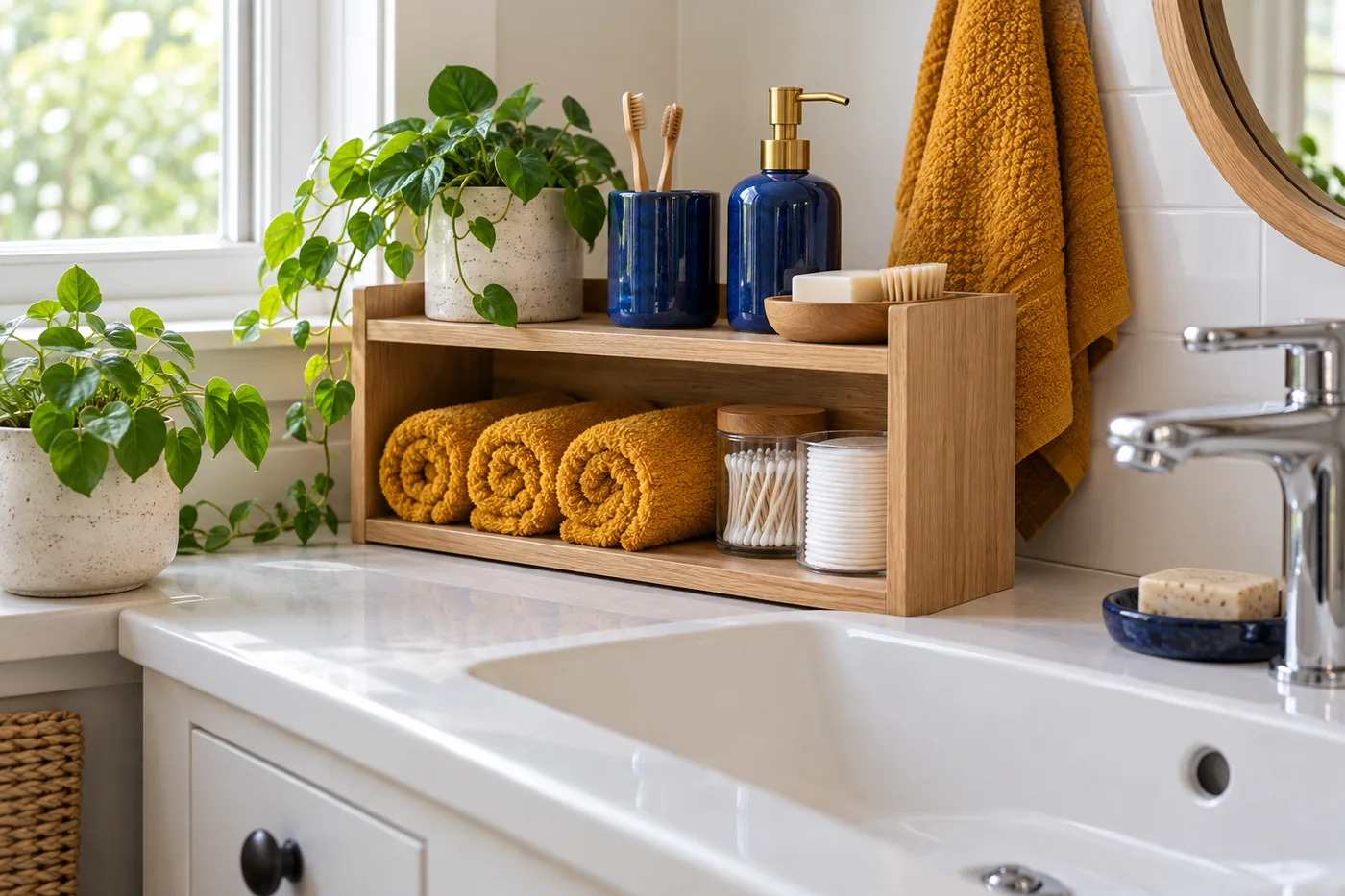
A small bathroom becomes difficult to use when every available surface has several jobs. The counter holds daily essentials, spare bottles, cleaning items, and things waiting to leave the room. A cupboard contains useful supplies, but finding them requires moving a row of unrelated objects. Better storage begins by separating those jobs and giving the most convenient space to the items used during ordinary daily routines.
You do not need to add a cabinet to make a meaningful improvement. A few clearer categories, a smaller active selection, and an easy route for returning items can change how the room works. Focus on countertops, drawers, shelves, and cupboards that already exist. Choose arrangements that fit their dimensions and the products' own storage directions, and keep the project centered on access and organization.
Follow the routine before sorting the products
Think through a typical morning and evening in the bathroom. What do you reach for first, what do you use together, and what gets put down because its home is awkward? Notice the end of the routine as carefully as the beginning. A product that is easy to retrieve but annoying to return will tend to remain on the counter.
List the few items used most days. Then list regular but less frequent items, unopened replacements, guest supplies, and objects that belong in another room. These distinctions are more useful than grouping everything solely by appearance or container size. Two identical-looking bottles may have very different roles if one is used daily and the other is an occasional extra.
Avoid turning the reset into a new grooming routine or an ambitious product-editing exercise. You are deciding where belongings live and how they move through the room. If you want to reconsider products separately, keep that decision bounded. The storage project can succeed even when you retain an extensive collection, provided the active portion has a sensible amount of accessible space.
Empty one area and inspect its limits
Start with the countertop or a single cupboard rather than spreading every bathroom item across the floor. Remove the contents, clean the area as appropriate for its materials, and measure the usable dimensions. Note the position of doors, hinges, pipes, and any fixed fittings. A cupboard with a central obstruction may need two narrow groups rather than one wide organizer.
Test the full movement of doors and drawers before committing to a layout. A bin can fit on the shelf but block the door's closing path, while a tall bottle may fit only when tilted. Those arrangements create daily inconvenience. Measure the containers you actually use, including pumps and handles, rather than choosing storage accessories from the shelf dimensions alone.
Respect the intended use and capacity of existing fittings and storage furniture. This reset does not require improvised mounting or changes to plumbing or electrical fixtures. If a space is unsuitable for an item under its own storage instructions, choose another location. Clear organization should make those instructions easier to follow, not encourage you to conceal incompatible items in the nearest available gap.
Give the countertop a clear job
Decide what the counter must support: a small daily selection, enough space to set down a wash bag, or a clear area for ordinary use. Keep only the items that earn a place through frequent use and suitable storage requirements. Everything else needs a cupboard, drawer, shelf, or location elsewhere. The counter should not become the default destination for anything without an assigned home.
A small tray can create a boundary for a daily group and make it easier to move the group when cleaning. It is useful only if the tray itself fits comfortably and the contents remain easy to access. A large tray packed with occasional items still occupies a large part of the counter. Choose the amount of active stock first and the container second.
For an illustrative bathroom with one narrow counter beside a basin, a household might keep only a compact daily group there and place hair accessories in the top drawer. Spare products could occupy a labeled cupboard bin. The improvement comes from separating daily use from replenishment. It does not depend on buying a particular style of tray or replacing every bottle with a matching dispenser.
Separate active products from unopened replacements
Keep current products together in their use zones and reserve a distinct place for replacements. Without that distinction, several similar packages can be opened while the one already in use disappears at the back. A labeled backstock bin or a clearly defined shelf section makes it easier to check supplies before shopping and easier for another person to locate a replacement.
Set a realistic limit based on how much spare stock fits in that defined space. You may want a replacement for a frequently used item but no reserve for a product used only occasionally. The goal is not to apply the same quantity to every category. It is to make replenishment deliberate and prevent promotions or forgotten purchases from silently taking over the cupboard.
When a replacement becomes the active item, update the shopping list if another backup is actually needed. Check the existing backstock before adding anything. A simple list entry is usually enough; a complete digital inventory may create unnecessary work for a small collection. Keep packaging information and follow the directions on the products rather than transferring items solely to make shelves look uniform.
Organize drawers by the way small items behave
Small accessories spread easily when a drawer has no boundaries. Hair ties, clips, combs, and other daily items may benefit from a few broad compartments. Group objects that are used together or easily confused, and leave enough room to see what is present. A deep pile in a tiny container can be as difficult to search as an undivided drawer.
Use shallow containers where the drawer allows them. Depth is not always an advantage for small objects: it can turn a category into a stack that must be emptied to inspect. If you already own suitable boxes or inserts, trial the arrangement with those before buying a dedicated set. A simple division that fits the contents is more valuable than a complete organizer with several unusable compartments.
Remove packaging and unrelated objects only when appropriate, preserving any instructions or details you need. Give spare parts an identifiable home rather than scattering them through several drawers. If you cannot tell what an accessory belongs to, place it in a short-term decision group and investigate during the next review. Do not let the main daily drawer become a permanent collection of unidentified pieces.
Work with the cupboard's shape
An under-basin cupboard often has interrupted space. Map the usable sections on either side of fixed fittings, then assign categories to those sections. Narrow bins may work better than a large basket that cannot be lifted out. Make sure you can retrieve the contents without catching on the cupboard or disturbing neighboring items. Easy removal matters when you need to inspect or clean the space.
Keep tall containers upright where they fit and can be reached comfortably. Avoid building a layout that depends on leaning several products against one another. If an item cannot fit without an awkward angle, it may need a different location. Storage that requires careful balancing tends to become difficult when a household member removes one piece in a hurry.
Use the back for a deliberate low-frequency category, not miscellaneous overflow. A clearly labeled replacement bin can work if you can bring it forward without dismantling the cupboard. If access to the rear is consistently poor, reduce the number of layers. The cupboard may hold less, but the supplies it holds will be easier to find and return.
Give each person a usable share
A shared bathroom needs clear ownership where products are personal and clear categories where supplies are communal. A small labeled bin per person can help, but it should fit the room and the collection. Do not force every household member into identical containers if their actual needs differ substantially. Agree on a fair allocation and a common boundary for the counter.
Consider whether a personal routine kit would reduce congestion. Someone might keep their everyday items together in a cupboard bin, bring it out while getting ready, and return it afterward. This works when the bin is easy to carry and the return location is accessible. It fails when the cupboard is too full to accept the kit without rearranging other supplies.
Name communal responsibilities as well as spaces. Decide who checks shared replacements, how low stock reaches the shopping list, and what happens when someone buys an extra package. These can be simple agreements. The useful outcome is that supplies do not become mysterious shared clutter for which no one feels responsible.
Keep towels and guest items proportionate
Count towels in relation to actual use and the household's laundry pattern. The active set needs a convenient home, while extras can live elsewhere if the bathroom is cramped. A bathroom cupboard does not need to hold every textile associated with the room. Moving infrequent guest items to another known location may free valuable space for the supplies used daily.
Choose a fold that fits the shelf and is easy to repeat. Rolling is not automatically more space-efficient, and elaborate folding can make putting laundry away slower. Test a short stack or simple row with the towels you own. Leave enough room to remove one without disturbing the entire arrangement. If the stack repeatedly topples, shorten it or change its orientation.
Create a small guest group only if it serves a real recurring need. It might include a towel set and the supplies you ordinarily make available, stored together in a labeled place. Avoid filling scarce bathroom storage with a speculative hotel-style collection. A modest, easy-to-find group is more useful than an extensive assortment that must be managed between visits.
Separate room supplies from household overflow
Bathrooms often inherit objects because they are small and a cupboard happens to be nearby. Spare shopping bags, unrelated tools, travel leftovers, and miscellaneous cables can gradually occupy the best storage. During the reset, ask whether each category supports a bathroom routine. If it belongs elsewhere, move it directly to an appropriate destination rather than creating a permanent relocation pile.
Travel items deserve a specific boundary. Keep a wash bag or travel collection together if you use it, review it after a trip, and return ordinary daily products to their usual homes. A partly unpacked travel kit can otherwise create duplicate storage for months. The goal is to know whether an item is in active daily use, reserved for travel, or simply waiting for a decision.
Keep cleaning products in accordance with their labels and household requirements, in their original identified containers. Organize them as a distinct category rather than mixing them with personal-care items. This article's storage approach does not replace product-specific directions. Clear separation and readable packaging help you locate the correct supplies without treating every bottle as interchangeable.
Test the setup during a busy morning
A fresh arrangement may look spacious because several products are temporarily elsewhere. Test it when all ordinary items are back and the room is being used normally. Notice what stays on the counter, which drawer becomes disordered first, and whether anyone avoids a particular cupboard. Those patterns show where the design adds effort or provides too little space.
Make a specific correction to the recurring problem. If hair accessories keep appearing by the mirror, their drawer may be too far away or too complicated. If backstock spills into the daily section, the reserve quantity may exceed its allocation. If a personal kit remains on the counter, its return space may be blocked. Each problem deserves a practical change rather than a reminder to be tidier.
Keep maintenance brief. During an existing cleaning or replenishment routine, return stray items, check the replacement area, and identify anything that has lost its role. Avoid emptying every cupboard repeatedly unless there is a clear need. A successful arrangement should make small resets sufficient most of the time, with larger changes reserved for changes in routine or household membership.
Check the room with the full collection present
Review the arrangement after ordinary laundry and shopping have returned everything to the room. A towel shelf can seem spacious while most towels are elsewhere, and a replacement bin may look sufficient just before supplies arrive. You want the system to work at a typical full point as well as between purchases.
Open each busy drawer and cupboard with the counter in normal use. Check that personal kits still have return spaces and that no category depends on borrowing another category's area. If the room feels crowded only at replenishment time, reduce reserve quantities or move suitable extras to another identified location. Do not rebuild the entire daily arrangement around an occasional oversized purchase.
Questions about limited bathroom storage
What if there is no drawer?
Use a few small containers on an existing shelf or inside a cupboard to separate daily categories. Prioritize easy removal and visibility over matching appearances. If the room cannot comfortably hold the entire collection, keep less frequently used items in another suitable known location. A small bathroom does not have to contain every related belonging.
Is it better to keep everything out of sight?
Only if the hidden locations remain convenient. A small visible daily group may work better than a crowded cupboard that causes every product to migrate back onto the counter. Decide what the room needs to support, then use concealed storage for the categories that do not need immediate access. Visibility is a tool, not a universal problem.
How do I prevent buying duplicates?
Give unopened replacements one defined home and check it before shopping. Use a shared shopping list if several people buy household supplies. If duplicates persist, make the category easier to see or simplify its label. The useful information is whether a replacement exists, not whether every package is arranged in a perfect row.
What should stay in a daily kit?
Include the items you reliably use in that routine and can store together according to their directions. Keep occasional extras elsewhere. The kit should be easy to lift, set down, and return without rearrangement. If it becomes crowded, review its contents before purchasing a larger container that occupies more of the limited room.
About this guide
Published by Toolivo Editorial. Our guides focus on practical household organization and adaptable room layouts.
Have a correction or a question? Contact Toolivo or read our editorial policy.