toolivo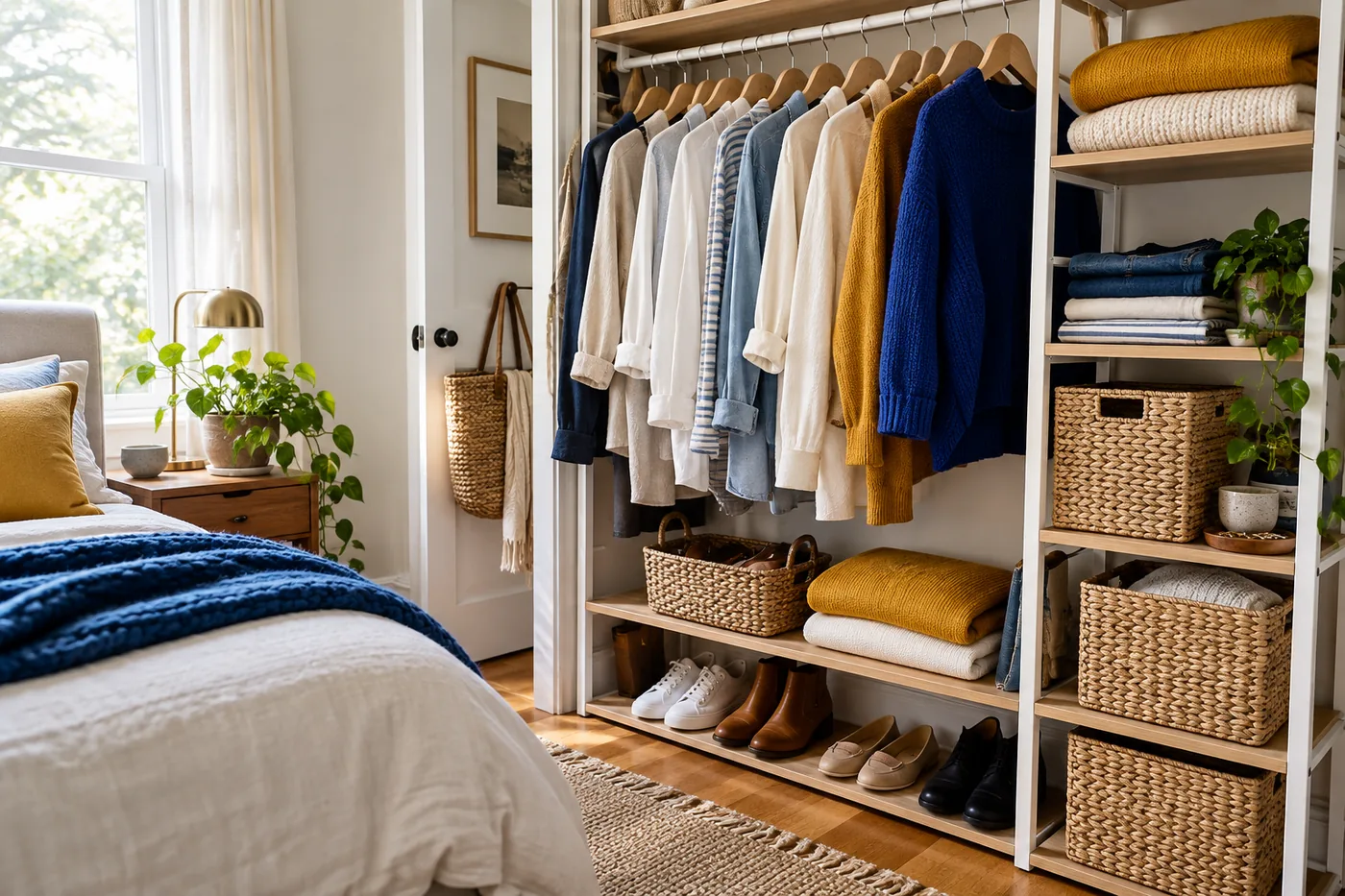
A wardrobe can be neatly divided by garment type and still make getting dressed difficult. The clothes you need on a busy morning may be scattered across drawers, the comfortable trousers you wear constantly may have no convenient home, and occasional outfits may occupy the easiest rail space. Organizing around your real week changes the starting question. Instead of asking what a complete wardrobe ought to contain, ask what your ordinary days require.
This approach does not demand a capsule wardrobe, a particular number of garments, or a new personal style. It helps you make the clothes you already use easier to see, combine, and put away. The arrangement should reflect your routines, available storage, and laundry habits. It should also leave reasonable room for clothes that matter to you even when they are worn less often.
Map an ordinary week before moving clothes
Write down the main situations in a typical week: working at home, commuting, attending a workplace, exercising, running errands, caring for household tasks, socializing, or other regular activities. Describe the clothing requirement in practical terms. “Comfortable layers for home working” tells you more than “casual,” while “two office days with a change of shoes” suggests a specific recurring sequence.
Do not build the map around an unusually busy holiday or an idealized version of your life. Include occasional routines separately so they remain visible without dominating the everyday arrangement. If your schedule changes frequently, think in recurring activities rather than named weekdays. The aim is to identify reliable patterns, not to predict every outfit you will wear.
Notice transitions as well as destinations. You may change after cycling, keep a separate outfit for messy hobbies, or need a fresh top before an evening event. These transitions explain why some categories accumulate or why one chair becomes a holding place. A wardrobe organized only around the start of the day may overlook the clothing decisions that happen later.
Separate the active wardrobe from everything else
Begin with the clothes used in current conditions and current routines. Set aside items that are clearly out of season, associated with a rare occasion, awaiting a repair, or uncertain in fit or preference. These are useful working categories, not immediate decisions to discard anything. Separating them lets you see how much of the convenient storage is occupied by clothes you actually reach for.
Check your active clothes in normal combinations. A top may be worn frequently but only with one particular pair of trousers; a jacket may require enough rail room to remain easy to retrieve. You do not need to try on every possible outfit. Identify obvious gaps between what the wardrobe makes accessible and what your routine requires. Sometimes the missing piece is merely stored in the wrong place.
Give uncertain items a bounded review area instead of allowing them to blend back into the active wardrobe. Write a short reason for uncertainty if that will help later: fit, repair, uncomfortable fabric, difficult pairing, or no current occasion. The next decision becomes more specific when the reason is visible. “Unsure” on its own can turn into permanent storage for unresolved choices.
Let frequency determine the best positions
Reserve your most comfortable reach area for clothes used repeatedly. This might be a middle drawer, the front part of a rail, or an open shelf beside the mirror. Everyday items should not require moving a stack of occasional clothes. The best position is personal: consider how you approach the wardrobe, which doors open fully, and which shelves you can inspect easily.
Use less convenient space for categories that genuinely need less frequent access. Formalwear, spare bedding stored in the same cupboard, or out-of-season garments may suit a separate labeled area if the space accommodates them. Follow the storage furniture's intended use, and avoid packing upper areas so tightly that retrieval becomes a complicated rearrangement. A location only works if you can put the item back as well as take it out.
An illustrative household member who works at home four days a week and visits an office once might give comfortable everyday clothes the easiest drawer and keep a small office group together on the rail. Someone with the opposite schedule would allocate space differently. Neither arrangement is more sophisticated. Both are successful when convenient storage reflects actual demand.
Choose a hybrid of garment groups and routine groups
Keeping all trousers together and all tops together makes the wardrobe easy to scan by type. Keeping complete outfits together can make specific mornings simpler. A hybrid often works best: broad garment categories for everyday flexibility, with a small routine group for a predictable activity. For example, exercise clothing might occupy one drawer section while ordinary tops remain grouped by type.
Avoid permanently assigning every versatile garment to one activity. A shirt worn for both work and social plans needs a home that remains easy to remember. You can keep it with other shirts while placing the associated accessories nearby. The goal is to reduce searching without creating competing storage rules for the same object.
Complete outfit groups are especially useful for a short, defined period. You might prepare several combinations before a busy week or collect the clothes needed for a specific trip. Afterward, return the pieces to their usual categories. This temporary grouping gives you the benefit of advance decisions without turning the wardrobe into a rigid schedule that must be rebuilt constantly.
Account for the laundry cycle
The practical size of an active clothing category depends partly on the interval between washing, drying, and putting clothes away. Count what is needed through your ordinary cycle rather than applying an arbitrary minimum. Include the clothes typically waiting to be washed or returned. An apparently overfull drawer may reflect a large collection, but an apparently sparse drawer may simply be showing you laundry day.
Look at where clean clothes pause. If a basket stays full because drawers are packed too tightly, the storage system is adding work at the final step. If hanging takes longer than you can usually spare, some suitable everyday garments may be easier to fold. Follow the garment's own care information when deciding how to handle it; organization should accommodate the care process rather than obscure it.
Make the return path simple. Keep the relevant drawer or rail section obvious, use a folding method you can repeat without special concentration, and avoid stacks that must be rebuilt to insert one item. A visually precise fold is optional. A reliable destination for clean clothes matters more because that is what keeps the wardrobe usable between resets.
Design a place for clothes worn but not ready for laundry
Many wardrobes fail at the in-between stage: an item has been worn, you intend to wear it again, and you do not want to mix it immediately with the rest. Without an agreed place, these clothes migrate to a chair, bed corner, or several door handles. Give the category a specific, limited home that suits your available space and the garments involved.
An existing hook, a short rail section, or one designated shelf can work if it remains easy to review. Keep the boundary modest. The point is to make a few next-use items visible, not to create a second wardrobe that avoids all decisions. Decide during your normal dressing or laundry routine whether each item returns to storage, is worn again, or joins the laundry.
If you share a bedroom, make the in-between area individual enough that ownership is clear. Two small designated spaces can work better than one shared pile. Labels may be unnecessary when the physical boundary is obvious. What matters is that everyone understands where the category belongs and when it should be reviewed.
Use drawers for visibility, not maximum compression
For small garments and everyday tops, arranging folded items so that several are visible at once can reduce rummaging. Whether you place them upright in a row or in short, distinct stacks depends on the drawer and the fabric. Test the arrangement with your actual clothes. Some items hold their shape easily; others are simpler to manage in a shallow pile.
Use dividers where they prevent categories from blending, such as separating socks from underwear or exercise tops from shorts. Do not add so many compartments that ordinary variations in laundry leave some sections crowded and others empty. Adjustable or easily moved boundaries are helpful when the mix changes through the week. A few broad sections often prove more forgiving than a grid of tiny cells.
Leave enough space to retrieve one garment and return another without pressing everything down. If the drawer only closes when the contents are carefully compressed, it has exceeded its useful capacity for that arrangement. Move occasional items, reconsider duplicates, or change the folding approach before looking for more elaborate organizers. The furniture's dimensions remain the same regardless of how many inserts you purchase.
Make the hanging area easier to scan
Group hanging clothes in a sequence you can explain in one sentence. You might place everyday shirts together, then trousers, then dresses or outer layers. Within a group, color order can help some people scan quickly, but it is optional. Frequency, length, and the way garments combine may provide more useful distinctions in a small wardrobe.
Allow garments enough room that you can move hangers without wrestling with the entire rail. Crowding makes it difficult to see pieces and discourages putting them away. Keep empty hangers in a predictable section or remove extras from the active rail if they create clutter. A tangle of unused hangers can make a wardrobe appear busier than its clothing collection actually is.
Use the lower space deliberately. Long garments may need a clear drop, while a section under shorter pieces could accommodate an existing shoe rack or a labeled container if it fits. Avoid filling every visible gap automatically. You still need to open doors, see contents, and move items comfortably. A useful wardrobe is a working space with clearance, not just a filled volume.
Keep accessories close to the decisions they support
Belts, scarves, bags, and other accessories are easy to scatter because they fit in many places. Choose homes based on when you choose them. A belt used with everyday trousers should be easy to locate during dressing, while an occasional bag might live with other less frequently used pieces. Broad categories are usually easier to maintain than highly detailed subdivisions.
Inspect the smaller items that block the useful ones. Empty packaging, unrelated receipts, spare buttons without context, and forgotten items in bags can occupy drawers without helping the routine. Give genuine repair supplies a separate labeled home. If an accessory belongs with one specific garment, storing them together may be clearer than adding it to a general collection.
For a small shared wardrobe, give each person's daily accessories a defined area. This avoids the gradual borrowing of space that happens when small items spread into unclaimed gaps. The allocation does not need to be visually symmetrical. It needs to be understandable and proportionate to the contents, with room to retrieve what is used most often.
Review the arrangement when life changes
A wardrobe map should change when your routine changes. A new commute, different work pattern, regular activity, or seasonal shift may alter which clothes deserve convenient positions. You do not need a complete reset every time. Move the affected categories first, then observe whether the new arrangement supports the next few ordinary weeks.
Use repeated friction as a signal. If one category always ends up on a nearby surface, its assigned home may be inconvenient or undersized. If you repeatedly overlook a useful garment, its location may not match the way you search. If a drawer remains difficult despite careful folding, it may contain too many competing categories. Each pattern suggests a specific adjustment rather than a general failure of tidiness.
Keep a brief wardrobe note if you discover a real need, such as an everyday garment that has no workable substitute. Include the routine it would support. This is more useful than buying storage or clothing in response to vague frustration. Sometimes reorganizing resolves the problem; sometimes it reveals a genuine gap. Let the evidence from your week guide the next decision.
Keep the next morning's choices temporary
If preparing clothes in advance helps, designate one small place for the next outfit. Use it for a particular upcoming day rather than allowing several speculative combinations to accumulate. Return anything you decide against to its normal category so the preparation area does not become another in-between pile.
This small routine can also test the wardrobe map. Notice whether choosing the outfit requires opening several unrelated containers or searching behind occasional items. If the same combination causes repeated searching, move the relevant categories closer together or make their labels clearer. Advance preparation is most useful when it reveals a better everyday arrangement as well as making one morning easier.
Questions about organizing clothes by routine
Will this make getting dressed too repetitive?
It does not have to. Routine-based organization changes access, not your freedom to combine clothes. Keep versatile pieces visible and use temporary outfit groups only when helpful. You can still enjoy variety while making the garments you use most often easy to find. The system should remove searching, not dictate a uniform.
What if my weeks are unpredictable?
Organize around recurring activities rather than weekdays. Keep a flexible everyday group and separate categories for the activities that require distinct clothing. Review those groups when your pattern changes noticeably. You need a usable starting arrangement, not an exact forecast of your calendar or a predetermined outfit for every possible event.
Should I buy matching hangers first?
Start by checking capacity and sorting the active wardrobe. Consistent hangers may make a rail easier to handle, but they cannot resolve a mismatch between the amount of clothing and the available space. Test the grouping with what you already own, then address a specific hanger problem if one remains.
How should sentimental clothes fit into the system?
Treat them as a separate collection with a deliberate amount of space. They do not need to compete with everyday clothing for the easiest drawer or rail position. Decide what you want to preserve and choose a suitable identifiable home. Separating sentimental value from daily usefulness allows both categories to be respected.
About this guide
Published by Toolivo Editorial. Our guides focus on practical household organization and adaptable room layouts.
Have a correction or a question? Contact Toolivo or read our editorial policy.