toolivo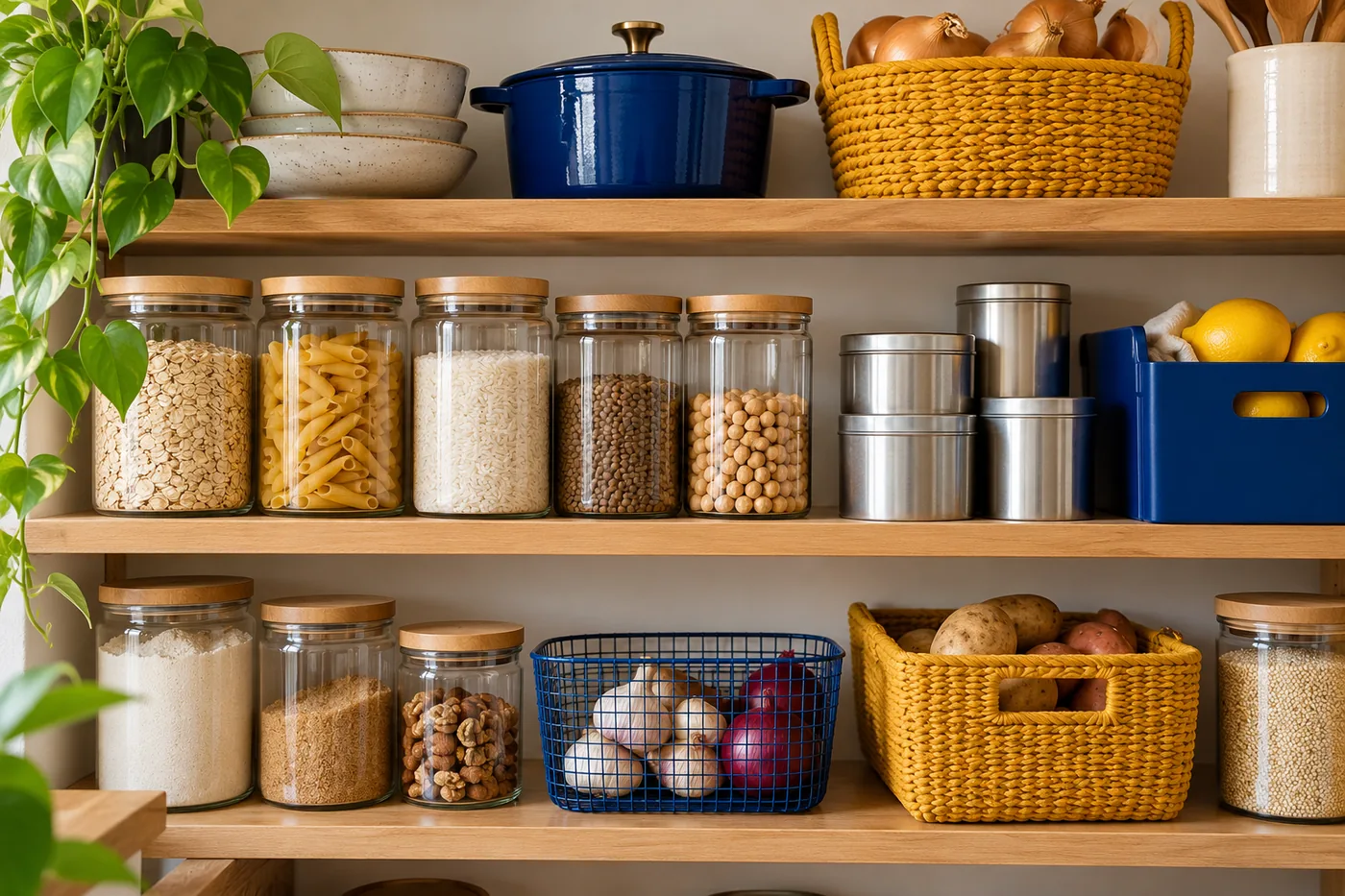
A pantry can look full while leaving you unsure what to cook or what to buy. The difficulty is often visibility rather than a shortage of containers. An open bag may be hidden behind an unopened one, breakfast ingredients may occupy three shelves, and a shopping list may reflect what you cannot see rather than what you lack. Clear zones give each kind of purchase a predictable destination and make the available stock easier to understand.
Your pantry might be a cupboard, two shelves in a kitchenette, or a collection of drawers. The same approach works at different scales: establish what is there, group it in ways that support actual meals, separate active packages from extra stock, and create a simple replenishment habit. You do not need matching packaging or a comprehensive catalog. You need an arrangement that stays legible after a normal grocery trip.
Begin with a useful inventory, not a shopping list
Choose one manageable section and remove its contents onto a clear surface. Sort packages into recognizable types as you go, keeping opened and unopened examples together for the moment. Record items you repeatedly buy, anything with several duplicates, and ingredients you had forgotten. The purpose of this inventory is to reveal patterns. Writing down every individual tea bag would add detail without improving most household decisions.
Read packaging rather than guessing about contents, directions, or any dates printed on it. Follow the product's own storage instructions. For this organization exercise, note where information is missing or difficult to access, and keep that information with the item. If you transfer a product later, your system still needs to preserve the details you rely on. A tidy shelf should not make a package harder to identify.
Do not add absent items to the shopping list automatically. First distinguish household staples from ingredients associated with a single recipe you no longer make. An empty space where couscous once stood does not necessarily mean couscous needs replacing. Inventory tells you what exists; your current cooking routine tells you what deserves ongoing space. Keeping those questions separate prevents the reset from becoming an unnecessary restocking project.
Identify the meals your shelves actually support
Think through a typical week of meals and snacks. List the pantry ingredients used for breakfast, straightforward lunches, quick dinners, baking, and drinks if those categories apply. Look for combinations you repeatedly reach for together. Oats and toppings might benefit from a breakfast section, while pasta and its usual accompaniments might belong near each other even though their packaging shapes differ.
There are two useful grouping methods: by ingredient category and by activity. Ingredient categories, such as grains or tinned foods, are easy to understand and scale well. Activity groups, such as weekday breakfast or packed-lunch extras, reduce searching during a particular routine. Most small pantries work best with a modest combination. Use activity groups where they create a clear advantage and ingredient groups for the rest.
Avoid assigning the same product several permanent homes. If chickpeas appear in salads, curries, and lunch bowls, keeping them in one known section is usually easier than distributing them among meal zones. You can place frequently paired products nearby without building a complete kit for every recipe. Overlapping zones become confusing when you cannot tell where a new package should go.
Map the shelves before choosing containers
Measure shelf width, depth, and the clear space above each shelf. Notice where cupboard doors, hinges, or nearby objects limit access. A deep shelf may have plenty of capacity but poor visibility at the back. A shallow shelf may work beautifully for one row of packages yet become awkward when you force a second row into it. Usable capacity depends on access as well as dimensions.
Assign the easiest-to-reach positions to the products used most often by the people who use the pantry. Place bulky packages where they fit comfortably and can be moved without rearranging several other categories. Follow the furniture's own load and use guidance, and avoid improvising extra shelving hardware as part of a simple organization reset. Existing shelves can often work better through clearer categories alone.
Sketch a rough map on paper. An illustrative cupboard might have breakfast and drinks on its most accessible shelf, meal ingredients below, and occasional baking supplies in a separate section. That example is not a universal ranking. In a household that bakes several times a week, baking supplies may deserve the most convenient area. Let actual frequency determine the layout.
Make active stock different from backstock
Active stock is the package currently being used. Backstock is an additional unopened package reserved for later. When both are mixed together, people may open another package simply because it is easier to reach. Give backstock a distinct place, even if that place is only a labeled section behind the active row. The distinction should be obvious without a verbal explanation.
Keep the backstock system proportionate to the household. A small kitchen might support one extra package of a few dependable staples and no extras for occasional ingredients. A larger household with less frequent shopping may need a broader reserve. Decide category by category rather than applying one rule to everything. The amount you can store comfortably and the amount you actually use should inform the boundary.
Use a simple replenishment signal. For example, when the last unopened package moves into active use, add the item to the shopping list. This avoids counting every week while still connecting the list to actual stock. If several people shop, use a shared list or one visible paper list. A pantry system loses much of its benefit when the stock information and the shopping decision live in separate places.
Use containers to solve particular problems
A bin can turn several small packages into one manageable group. It may help with sachets, snack packets, or baking decorations that otherwise spread across a shelf. Choose a bin you can pull forward and inspect easily, and label the group with a word people already use. An attractive container that conceals everything inside can make a pantry less readable unless its category is especially clear.
Decanting can be useful when the original package is awkward to close or repeatedly collapses into neighboring items. It also adds work: transferring contents, keeping containers suitable and clean, preserving package information, and handling the remainder when a new purchase exceeds the container's capacity. Decide whether that work solves a recurring problem. Leaving products in their original packaging is a perfectly workable organizational choice.
Avoid choosing a container size from the package's appearance alone. Check the amount you usually buy and whether the container accommodates it comfortably. Keep any original instructions and identifying details you need. If a transfer leaves half a bag elsewhere, you now have two storage locations to manage. Sometimes a supportive open bin for the original package is the simpler answer.
Give deep shelves a retrieval strategy
The rear of a deep shelf needs a defined purpose. Without one, it tends to collect forgotten duplicates and ingredients that were moved aside during a rushed unpacking session. One approach is to use the back for clearly separated backstock. Another is to use a removable bin that brings a whole category forward. Choose a method that lets you inspect the back without emptying the front.
Arrange tall and short packages so the shorter ones remain visible where practical. Do not assume that a tiered riser will help every shelf: it takes up height and may not suit large bags or irregular packets. Try the basic arrangement first. If you repeatedly overlook a specific row of small packages, a suitably sized riser may address that precise visibility issue.
Resist creating more than one hidden layer. A bin behind another bin can be reasonable for an infrequently used category, but three nested obstacles make ordinary checking burdensome. If the shelf only works when you remember an unseen inventory, simplify it. A slightly less densely packed shelf can be more useful because it lets you see what is available before buying more.
Set boundaries for snacks and specialty ingredients
Snacks often arrive in packages that occupy much more space than their contents. Decide whether you want to keep the outer packaging or group the individual packets in an existing basket. Either can work. What matters is making the quantity visible and giving the category a defined amount of room. An overflowing snack area should trigger a stock check before it triggers the purchase of another basket.
Specialty ingredients deserve a different decision from staple ingredients. Group them where you can find them, but do not build automatic replenishment around something used for a single occasional recipe. A short note listing possible meals can help you incorporate an already-owned ingredient into planning. Keep that note realistic; a pantry reset does not oblige you to undertake a series of elaborate cooking projects.
For example, a household might find three partially used baking decorations, several noodles, and four bags of different grains. It could reserve one small baking bin, give noodles a clear dinner section, and plan a few ordinary meals around the grains. The useful result is not identical packaging. It is knowing which purchases can wait and which existing ingredients are likely to be used next.
Make unpacking groceries almost automatic
A successful zone system should guide new purchases into place with little thought. When groceries arrive, check whether an active package already exists before opening or placing another one at the front. Put additional stock in its designated area, keeping the active item visible. This small sequence prevents a familiar pattern in which the newest purchase hides the package that was already in use.
Keep the unpacking rules brief enough to share. “Breakfast here, dinner ingredients here, extras in this section” is more likely to survive a busy evening than a long list of detailed exceptions. Ask another household member to put away a few items. If their choices differ from yours, investigate whether the labels are ambiguous or whether a category has become too broad.
Allow one temporary landing place for purchases that genuinely do not fit the existing map. Review that place during the next routine pantry check. It should be a prompt to decide, not an expanding overflow zone. A new staple may deserve a permanent location; a one-time purchase may simply need a visible short-term place until its planned use.
Review demand instead of repeatedly reorganizing
After a few ordinary shopping cycles, look for zones that are consistently too full or nearly empty. These patterns tell you about demand and allocation. If breakfast spills into neighboring sections every week, it may need more space. If a baking section remains mostly unused, it may be larger than necessary. Change the shelf map in response to these observations rather than rearranging because the display no longer looks freshly styled.
Check the list-making habit at the same time. Are duplicates still arriving because people cannot see the backstock, because nobody checks before shopping, or because the shared list is difficult to access? Those are different failures. Improving a label will not fix an unused shopping list, and a new app will not fix an opaque pile of extra packages.
Keep a small amount of flexible space if you can. Shopping sizes change, guests alter demand, and a seasonal routine may bring different ingredients into regular use. Flexible space can be a partly empty bin or a clear section at the end of a shelf. Its purpose is to absorb ordinary variation without forcing every other category to move.
Keep a useful map for an unfamiliar shopper
A short note inside the cupboard can help someone who shops or cooks less often. List the main zones and the rule for replacements, using the same words as the shelf labels. This is particularly useful when a household changes its arrangement after years of keeping ingredients in different places. The note can be temporary while the new pattern becomes familiar.
Test the map with three ordinary tasks: finding a breakfast staple, checking whether an unopened replacement exists, and putting away a newly purchased dinner ingredient. If someone needs further explanation for each task, simplify the categories. A pantry map should communicate the arrangement, not compensate for an arrangement whose logic is too complicated to remember.
When more than one shopping list exists, choose a single place for pantry replenishment requests. A paper list and a phone list maintained independently can both appear correct while producing duplicate purchases.
Questions about building pantry zones
Do I need to empty the whole pantry at once?
No. Work one shelf or category at a time if space or time is limited. Finish returning that section before starting another. You can still compare duplicates by keeping a short inventory as you go. A completed small section is more useful than an ambitious full reset that leaves every package on the kitchen counter.
Should I organize alphabetically?
Alphabetical order can work for a narrow category such as a collection of clearly labeled spices. Across an entire pantry, meal routines and ingredient groups are usually easier to maintain. Choose the arrangement that helps people both find an item and return a purchase correctly. A system that only its creator understands needs simpler categories.
What if bulk purchases do not fit?
Treat available storage as part of the purchase decision. Identify the destination before buying a larger quantity, and compare the convenience of the purchase with the extra space and handling it requires. If you already own the stock, group it in one known backstock area and avoid replenishing the category until the quantity becomes manageable.
How detailed should an inventory be?
Start with the items that create repeated confusion: dependable staples, expensive duplicates, or categories hidden on deep shelves. Record enough to guide the next shopping decision. If maintaining the inventory takes more effort than checking the pantry itself, simplify it. Visible zones and a clear replenishment signal often provide most of the information a household needs.
About this guide
Published by Toolivo Editorial. Our guides focus on practical household organization and adaptable room layouts.
Have a correction or a question? Contact Toolivo or read our editorial policy.