toolivo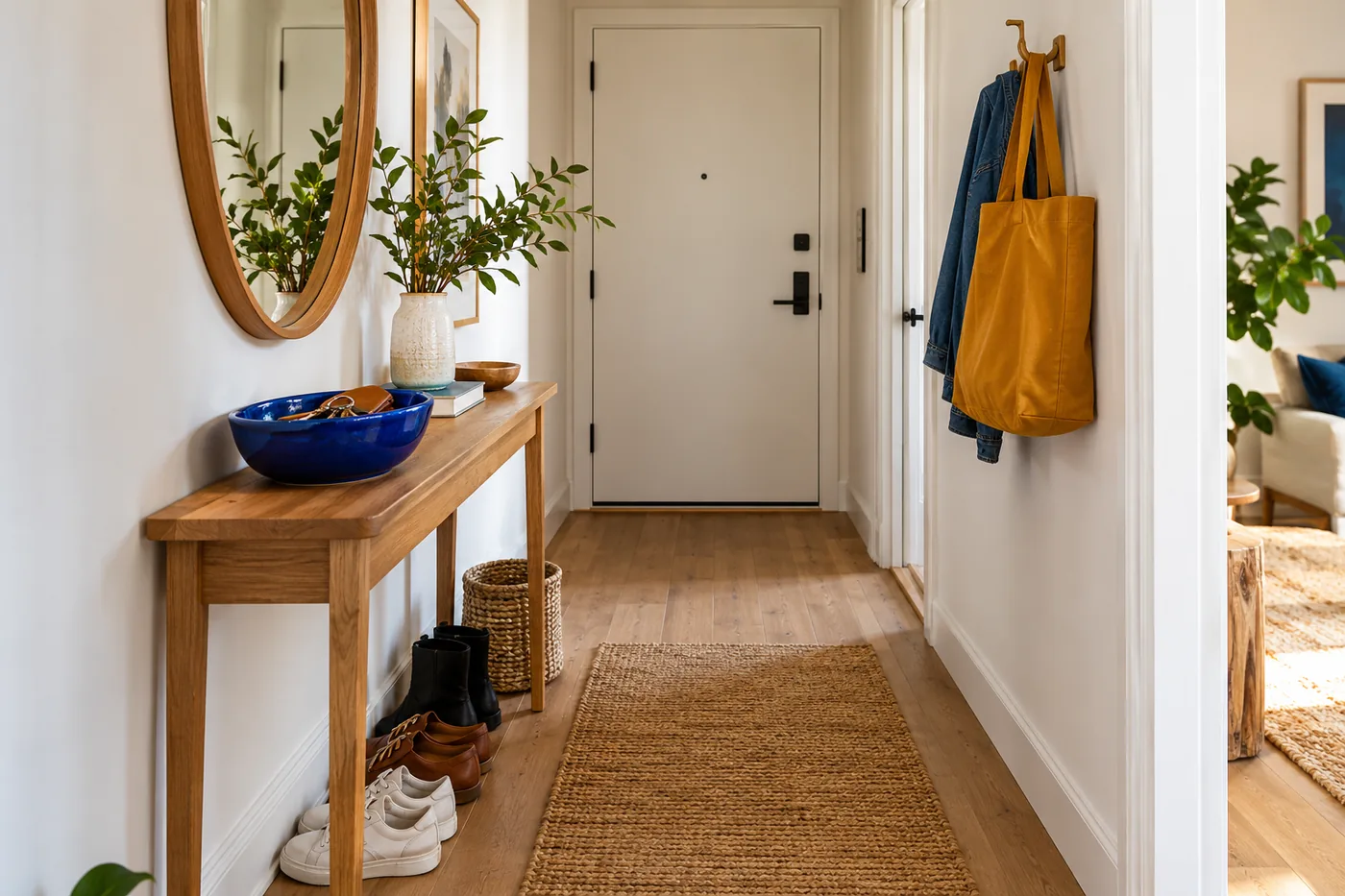
An entryway has to cope with a surprisingly complicated moment. Someone arrives carrying a bag, looking for a place for keys, taking off shoes, and trying not to block the person behind them. In a narrow hall, adding more furniture can make every part of that sequence harder. The useful question is not how much storage fits. It is what the entrance needs to handle during the busiest arrival of the day.
A workable entryway can be very small. It may consist of a clear route, a dependable place for a few objects, and a separate storage location elsewhere for everything that does not need to stop at the door. This guide helps you establish those roles before choosing a console, basket, bench, or rack.
Watch an ordinary arrival
For a few days, notice what crosses the threshold and where it lands. Do not reorganize immediately. A bag placed on the floor may mean there is no convenient resting place, but it may also mean its owner is opening a cupboard with both hands. Shoes scattered near the doorway might indicate that the shoe storage is too far away or requires too many separate movements.
Write a short arrival sequence for each household member. One person may enter with a bicycle helmet and work bag. Another may bring a shopping trolley. A third may need somewhere to sit while changing shoes. These needs are more useful design information than the number of hooks shown in an inspiration photograph.
Also observe departures. Items waiting to leave often occupy the same limited surface as things coming in. A parcel for return, a borrowed book, and tomorrow's bag are not permanent possessions of the entrance. Give them a temporary role with a clear end point so they do not quietly become part of the furniture.
Protect the route before adding storage
Open the entrance door fully and check nearby interior doors. Walk the route carrying the bulkiest ordinary object, such as a shopping bag or laundry basket. Include the space needed to turn and to stand while someone else enters. A narrow cabinet is not useful if its open door blocks the only comfortable path through the hall.
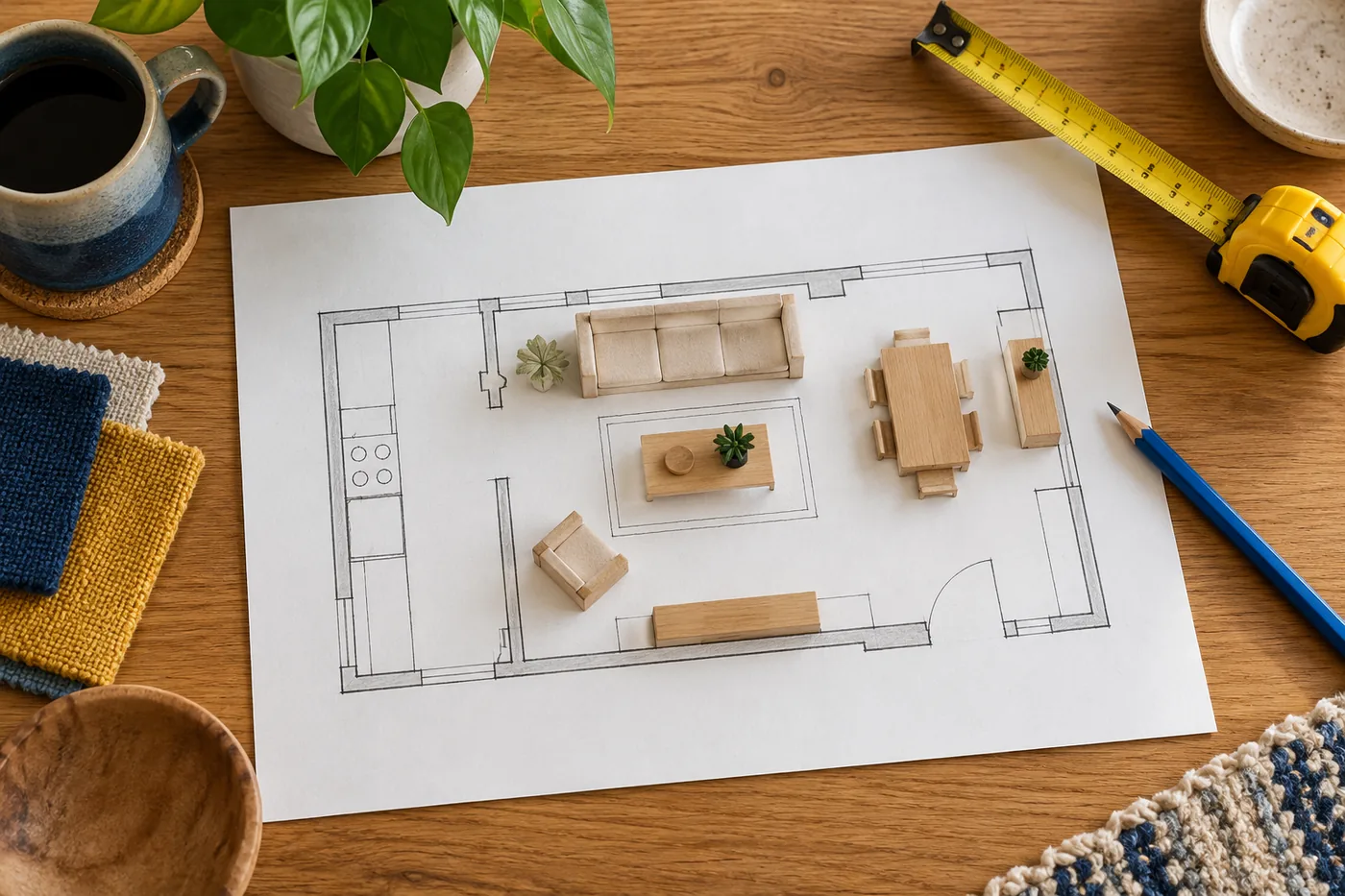
Mark a furniture boundary on a sketch. Rather than selecting a unit and hoping it fits, establish the maximum depth that preserves a usable route. Test the boundary with a cardboard box or another safe temporary marker. Keep the test out of any required escape path, and remove it if it creates a trip hazard.
Avoid treating the entrance as a spare storage room. Its first job is access. If a large shoe collection cannot fit without reducing that function, move the less-used pairs elsewhere. The front door should not have to compete with objects that are needed only occasionally. This is a distribution problem across the home, not a failure of the entrance itself.
Define an everyday allowance
Choose what genuinely needs a place near the door. For many households, that is a small number of daily shoes, currently used outerwear, keys, and a bag. The exact allowance should follow actual use, not a fixed rule. A household whose shoes change with work shifts may need a different arrangement from one where everyone wears the same pair most days.
Make the allowance visible through the available space. A shallow tray can define the resting place for keys and a wallet. One compartment per person can make a shared shoe area understandable. The container is a boundary, not a target to fill. If the objects overflow regularly, investigate whether the allowance is unrealistic or whether occasional items are drifting into daily storage.
Separate current use from backup. Spare umbrellas, seasonal boots, rarely worn coats, and travel bags can often live in another cupboard. Label that secondary location if necessary. A small active collection beside the door is easier to manage when the household knows exactly where the rest belongs.
Choose the simplest landing surface
A landing surface should support the arrival sequence without becoming a display that is too delicate to use. It might be a small existing shelf, a shallow console, or a tray inside a nearby cupboard. Before buying anything, test the height and reach using furniture already available. The place should be easy to find while carrying a bag.
Keep the surface's function specific. Keys and small daily essentials need little space; incoming paperwork can consume much more. If letters belong at a separate household paper station, move them there after arrival instead of allowing the entrance to become a filing system. Decorative objects are welcome when they do not remove the room needed for the practical task.
Depth can be more important than width. A long shallow surface may preserve circulation better than a short deep table. Check protruding corners and handles, especially where people turn. If you rent or need a wall-mounted solution, follow the lease, the wall's suitability, and the installation instructions. Do not assume an adhesive product can support an unspecified load.
Make shoe storage easy to finish
The best shoe storage is one people will use while tired or in a hurry. A closed cabinet looks calm but adds a door-opening step. An open rack is immediate but leaves shoes visible. A basket may work for flexible slippers but can make structured shoes difficult to retrieve. Choose the tradeoff that matches the actual collection.
Arrange daily pairs so they can be returned without rearranging other pairs. If returning one shoe requires lifting three others, the floor will often become the easier alternative. Leave enough room for the largest current shoes rather than planning around the smallest pair. Test the system with the whole household's everyday footwear present.
Create a separate decision for wet or dirty shoes, following the needs of the floor finish and the footwear. A suitable removable mat or tray can contain everyday mess, but it still needs attention and should not make the doorway slippery. Keep any cleaning products stored safely in their proper location rather than adding them to an open entrance display.
Give bags and coats a realistic home
Think about the whole bag, including straps, side pockets, and the space needed to lift it. A hook may hold the weight but position the bag where it knocks against someone passing. A cubby may look generous until a rigid work bag is placed inside. Test with the actual objects whenever possible.
Coat storage changes by season and household size. Avoid filling the most accessible space with every coat owned. Keep the current selection close to the door and store the rest elsewhere if the home allows it. Ensure that any furniture or wall fittings are suitable for their intended load and installed according to the manufacturer's instructions.
If bags regularly land on a bench, decide whether that is acceptable. A bench cannot reliably be both a seat for changing shoes and an unrestricted storage surface. You may reserve one end for a bag, but the sitting area needs to stay available when someone needs it. Clear roles reduce daily negotiation.
Plan a small outgoing area
Choose a modest place for objects that must leave soon. It could be a labeled basket in a nearby cupboard or a specific section of the landing surface. The location should be noticeable without obstructing the route. Avoid leaving parcels where they must be stepped over; visibility is not worth creating a barrier.
Attach the object to a real next action. A library book belongs with the bag taken on the library trip. A parcel return needs the information required for that return, kept appropriately private. An object marked simply as "to do" can remain indefinitely because the label does not explain when or how it will move.
Review the outgoing area when preparing for the next day. Remove items whose plan has changed. If a return can no longer happen, make a new decision instead of leaving the package as a reminder of an expired task. Temporary storage needs an exit rule or it becomes permanent storage by default.
An illustrative entrance with no room for a bench
Consider a household of two adults with a short narrow hallway, one shallow cupboard, and no comfortable space for a freestanding bench. Their first idea is a console with baskets underneath. A floor test shows that the console would make carrying shopping awkward and would interfere with the cupboard door.
They instead use one cupboard shelf for daily shoes and a small existing tray on an internal ledge for keys. Current coats occupy the reachable hanging area; spare coats move to bedroom storage. Bags go directly to their normal room after arrival. A chair just inside the adjoining room provides a place to change shoes without forcing a seat into the hall.
This arrangement has less visible furniture but supports the important actions. It also has a limitation: visitors need guidance about where to leave coats. The household accepts that occasional inconvenience in exchange for a clear daily route. A successful entryway does not have to perform every possible task in the same square metre.
Make shared use easy to understand
Use labels only where they reduce uncertainty. Names or simple categories on closed compartments can help housemates find the right place. A tray that obviously holds keys may need no label at all. Too many instructions can make a small entrance feel like a noticeboard, while a few well-chosen boundaries can explain the system quietly.
Discuss the arrangement with the people who use it. Ask which movement is awkward, what is often forgotten, and which belongings have no reasonable home. Avoid interpreting a repeated pile as proof that someone is careless. The storage may be positioned for one person's height, schedule, or habits while making another person's routine unnecessarily difficult.
Keep private belongings private. Mail, identification documents, spare keys, and access information should not be displayed simply to make an attractive vignette. Consider what can be seen from the open front door. An entryway is a transition between public and private space, so its organization should respect that distinction.
A short weekly reset
Remove everything that does not belong to current daily use. Return spare shoes and outerwear to their secondary locations. Deal with outgoing objects, empty unnecessary packaging, and check whether the entrance still works with the door open. This is a focused reset, not a demand to reorganize the whole home.
Look for one repeated irritation. Perhaps a bag strap catches on a handle, a tray is too small, or someone needs a lower storage position. Change that detail and observe the result. Small adjustments based on use are usually more informative than replacing the entire arrangement after a single untidy evening.
Finish by leaving a little capacity unused. Empty space is useful when a visitor arrives, a shopping delivery comes in, or the weather changes suddenly. An entrance arranged at maximum capacity has no way to absorb ordinary variation. A modest buffer helps the system recover without needing an immediate major tidy.
Prepare for visitors without permanent overflow
An occasional visitor does not need a permanent allocation equal to a resident's daily storage. Decide in advance where a guest's coat and bag can go, then keep that option available when someone is expected. A nearby room may be more comfortable than crowding the entrance with extra hooks, chairs, and baskets that remain unused most of the time.
Explain the arrangement simply on arrival. Visitors should not have to guess which cupboard is appropriate or whether a decorative seat is intended for use. A clear invitation to leave belongings in a particular place makes the entrance welcoming without requiring more furniture. After the visit, restore the everyday arrangement so temporary accommodations do not quietly become another permanent layer of storage.
Practical questions
Can an entryway work without buying furniture?
Yes. Start by relocating occasional items, defining a place for daily essentials, and using an existing cupboard or tray. A clear route may be the most valuable improvement. Buy only after you can describe the specific missing function and its maximum dimensions. This prevents a storage purchase from becoming another object that needs to be accommodated.
What if there is no entrance hall at all?
Create a small arrival zone just inside the room, using its existing furniture where possible. Keep the zone visually and physically contained, and prevent it from spreading across the main living surface. The sequence still matters: arrive, set down essentials, remove what needs removing, and carry remaining belongings to their proper homes.
How much should stay by the door?
Enough to make the next ordinary departure easy, with room for a normal arrival. That is a better test than an arbitrary number of pairs or hooks. If the area is constantly full before anyone comes home, reduce the active collection or move one function elsewhere. The entrance needs working space as well as storage space.
About this guide
Published by Toolivo Editorial. Our guides focus on practical household organization and adaptable room layouts.
Have a correction or a question? Contact Toolivo or read our editorial policy.