toolivo
Shared storage is easier to maintain when people know what space belongs to whom, what belongs to everyone, and how changes will be discussed. Without those agreements, an empty shelf can look available to one person and reserved to another. A cupboard may appear evenly divided while one housemate receives the easy shelf and another must move several boxes to reach their belongings. The practical question is not just how much space each person has, but how usable that space is.
A good arrangement does not require identical possessions or identical habits. It needs clear boundaries, reasonable access, and a way to handle ordinary variation without renegotiating the whole home. Start with one shared area that causes friction, such as a hallway cupboard, pantry shelf, bathroom cabinet, or living-room storage unit. A workable agreement in one area is easier to extend than a comprehensive set of rules made before anyone has tried them.
Describe the problem without assigning motives
Begin with observable difficulties: shoes block access to the cupboard, shared supplies are hard to locate, one shelf repeatedly overflows, or deliveries remain in the hallway. These descriptions identify a storage problem that can be changed. Assumptions about laziness, selfishness, or carelessness tend to shift the discussion away from the practical arrangement and toward defending intentions.
Ask each person what they need the space to do. Someone may need quick access before an early shift, another may have a bulky hobby item, and another may prefer personal belongings to stay out of shared areas. These needs are not automatically compatible, but naming them creates something concrete to discuss. A storage plan designed without this information may solve one person's inconvenience by creating another's.
Keep the first conversation bounded. Choose the area, identify the recurring problem, and agree to test an arrangement. You do not have to settle every difference in household style at once. A short trial gives everyone evidence about access, capacity, and maintenance, which is often more useful than debating hypothetical examples indefinitely.
Inventory the space and its users
Empty or inspect the selected area together where practical. Identify which belongings are personal, which are shared, and which have unclear ownership. Do not dispose of or relocate another person's possessions to a place they cannot find without their agreement. Put unidentified items in a visible temporary review group so their status can be resolved before the new allocation is finalized.
Measure the shelves or compartments and note practical limitations. A narrow rear section, an awkward door, or a shelf that is difficult to reach changes the value of the space. Consider the shape of the actual belongings: a tall item may require height more than width, while several small objects may work in a shallow bin. Equal dimensions do not always produce equally useful storage.
List everyone who needs regular access, including whether visitors or occasional household members use particular communal items. This does not mean every person needs a permanent personal compartment in every room. It helps you distinguish personal allocations from a shared access zone so that ordinary communal supplies do not become buried inside one person's section.
Separate personal, shared, and temporary space
Personal storage is allocated to a particular housemate. Shared storage holds items everyone has agreed are communal. Temporary storage handles arrivals, items awaiting collection, or short-lived projects. These roles should be visually distinguishable, even if the distinction is only a shelf label or a clear division within a cupboard. Ambiguity encourages accidental encroachment.
Give shared items a specific home outside personal sections whenever possible. A communal household supply should not require opening someone's private box. If space makes a combined area necessary, agree on an obvious boundary and an access arrangement. The point is to avoid turning an ordinary retrieval into a question about whether touching nearby belongings is acceptable.
Keep temporary space small and attach a review routine to it. A delivery shelf or returns basket can be useful, but temporary should describe a process, not an unlimited duration. Agree on how people will flag items that need collecting or a decision. When the space fills, review the contents rather than quietly allowing it to spread into the permanent allocations.
Decide what fairness means for this area
Equal shelf width is one possible starting point, but fairness may also involve accessibility, item size, and the purpose of the room. A household might divide personal pantry space equally while allocating a shared cupboard according to the communal equipment stored there. The important part is making the reasoning explicit so that differences are understood rather than interpreted as favoritism.
Distinguish needs from preferences without dismissing either. A housemate may need a certain dimension for an existing item, while another prefers several small compartments. You may be able to accommodate both by varying the shape of allocations rather than the total usable space. If a tradeoff remains, discuss it openly and check whether another storage location can provide a more balanced arrangement.
For an illustrative two-person cupboard, one person might take a taller lower section for a folded cart while the other receives two shallower shelves for smaller belongings. Both also retain access to a common cleaning-supply section stored according to product instructions. This can be fair if both agree that the allocations suit their needs. The same division could be unfair in a different household with different belongings.
Make boundaries visible without over-labeling
Use names or simple category labels where ownership is otherwise unclear. A shelf marked with a person's name can be enough; every individual object does not need a label. For communal areas, choose terms that describe the contents plainly, such as “shared table linens” or “household replacements.” Avoid vague words like “miscellaneous” that provide no guidance about what belongs there.
Physical containers can reinforce boundaries when several small items share a shelf. They also consume space, so choose them only where they help. An existing box or basket may be sufficient for a trial. Measure the contents and the shelf before purchasing matching bins, particularly when different housemates need different proportions of storage.
Agree on what a boundary means. Does each person manage the inside of their own section freely? Must the cupboard close without moving other people's items? Can a temporarily empty section be borrowed, and only after asking whom? Simple answers prevent a label from becoming a false promise of clarity while the practical expectations remain unspoken.
Give busy routes room to work
Storage near entrances and shared work surfaces receives more traffic than a cupboard used occasionally. Consider the sequence of arriving home: setting down a bag, removing outerwear, sorting post, or placing purchases before unpacking them. A plan that omits a common step often results in belongings landing wherever there is a gap, regardless of the permanent storage labels.
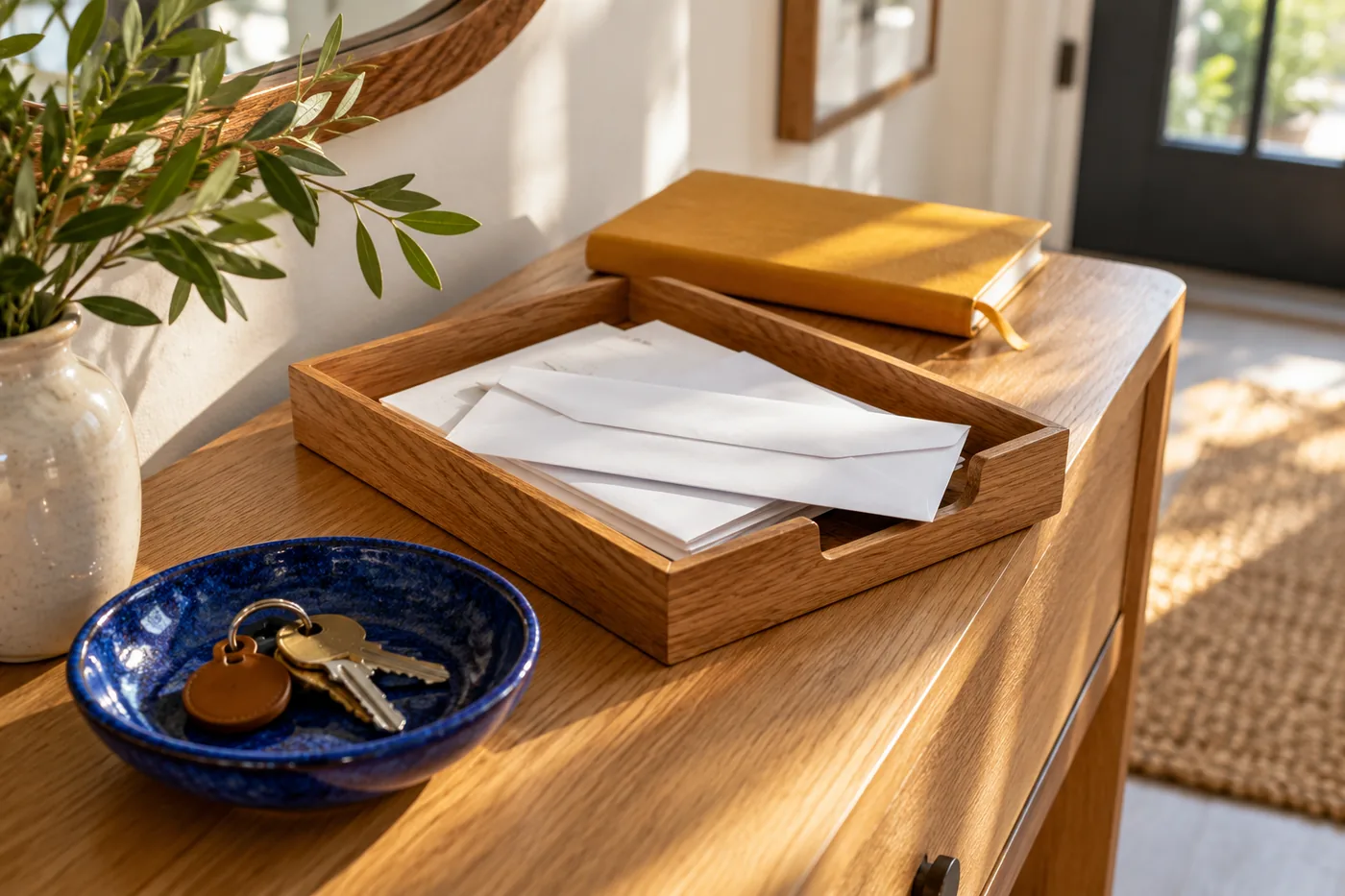
Create a modest landing area if the space permits and define what happens next. A bag hook or a small delivery spot might support the arrival routine, while long-term belongings belong elsewhere. Keep access to doors and the intended use of the room in mind, and use existing storage fixtures according to their design. The aim is a practical layout, not an improvised installation project.
Observe peak use. Two people getting ready at once may need separate retrieval paths or a little additional clearance around frequently used storage. A cupboard that works well when one person uses it slowly may be frustrating during overlapping routines. Moving one high-frequency category can sometimes reduce congestion without increasing the total amount of furniture.
Agree on borrowing and communal supplies
Shared location does not automatically mean shared ownership. A personal item stored in a common cupboard may still require permission to borrow. State the household's expectations directly, especially for tools, hobby supplies, food containers, and items that are easy to mistake for communal equipment. Clear ownership prevents the storage system from making promises nobody intended.
For genuinely shared supplies, agree on how replenishment happens. One person might check stock while anyone can add to a common shopping list, or responsibility might rotate. Keep the arrangement consistent with the household's existing approach to costs and chores. Storage labels alone cannot resolve uncertainty about who buys replacements or who notices that the supply is low.
Set a return rule that is easy to follow: shared items return to their labeled home after use, or at another clearly agreed point if immediate return is impractical. If something repeatedly remains elsewhere, ask whether its home is inconvenient. The first useful adjustment may be moving the category, not repeating the same reminder more insistently.
Handle overflow as a decision
Overflow is information about the relationship between possessions and allocated space. When one person's section is full, the next step should be a decision about contents, another location, or a jointly agreed change. Quietly expanding into a neighboring section avoids the conversation temporarily but weakens the entire arrangement. An explicit boundary only works if changes to it are also explicit.
Offer a process that does not turn every extra object into a dispute. A person can identify the item, explain how long the extra space is needed, and ask about a particular temporary location. The household can agree to a review point. This makes a short-lived need distinguishable from a permanent reallocation and gives the affected housemates something concrete to consider.
Do not assume that buying more storage is always the fair solution. Additional furniture may occupy common floor space, create a cost question, or make access worse. First check whether existing space is being used for forgotten belongings, unclear shared stock, or an allocation that no longer reflects current needs. Purchase decisions are easier when the actual capacity problem is understood.
Build a reset that does not assign one person every job
A shared reset can be brief if each person returns their own belongings and shared categories have clear ownership for maintenance. Choose a routine that fits the household, such as checking the entrance area during an existing cleaning session. The objective is to restore agreed boundaries, identify exceptions, and keep access comfortable. It should not require one housemate to sort everyone else's possessions.
Separate daily returns from occasional review. Putting a borrowed item back is an immediate habit; reconsidering shelf allocation is a less frequent conversation. Combining these into one vague instruction to “keep it tidy” makes responsibility harder to understand. Specific actions are easier to notice and discuss without arguing about different aesthetic standards.
If one person is repeatedly doing the reset, investigate why. Others may not understand the labels, may find the storage inconvenient, or may simply be relying on the first person's effort. The solution may involve changing the layout, clarifying responsibility, or revisiting the agreement. Do not let a storage project quietly establish a permanent unpaid organizing role by default.
Review the trial using concrete observations
After the arrangement has been used through ordinary routines, ask what became easier and what still caused friction. Did labels reduce uncertainty? Could everyone reach their belongings? Did temporary items leave the landing zone? Use specific examples from the trial. A shelf that repeatedly overflows or an item that always lands elsewhere points toward a practical adjustment.
Change only the parts that need changing. If the personal allocations work but the shared replacement bin is hard to access, move that bin without redesigning every shelf. A stable arrangement is easier to learn, and small revisions help you tell what actually improved the experience. Constant comprehensive reorganizing can make even a reasonable system feel unreliable.
Revisit the agreement when circumstances change: someone moves in or out, a regular activity adds equipment, or a formerly shared item becomes personal. Clear storage is not a once-only contract. It is an arrangement that remains understandable because changes are acknowledged. Keeping that process straightforward is part of making the home comfortable to share.
Record changes in the place people already check
After agreeing on an allocation, record the essential points in the household's usual shared note or message thread. Include the area, the personal boundaries, the communal categories, and any temporary borrowing arrangement. This is a practical memory aid, particularly when someone was absent during the conversation. Keep the wording descriptive and concise.
When a temporary arrangement ends, restore the original space or explicitly agree on a new one. Remove outdated labels or notes at the same time. Conflicting information can restart a disagreement even when everyone originally understood the change. A current, simple record helps people check the arrangement without asking one housemate to become its permanent interpreter.
Questions about storage with housemates
Does every person need exactly the same amount of space?
Not necessarily, but differences should be discussed and agreed rather than assumed. Compare usable access and the shape of actual belongings, not only shelf measurements. Equal allocation may be the simplest solution in some areas. In others, different-shaped spaces can meet each person's needs more effectively while still feeling balanced.
What if a housemate dislikes labels?
Use physical boundaries or a simple shelf map if those are clear enough for everyone. Labels are a tool for reducing ambiguity, not a required decorative style. Try the least intrusive approach that works, then revisit any categories that remain confusing. The shared understanding matters more than the particular method used to display it.
Can someone borrow an empty personal shelf?
Only according to the household's agreement. Ask before treating a temporarily empty section as available, and establish when it will be returned. The owner may have belongings in use or away from home that normally occupy it. Visible emptiness does not reliably indicate that the space has been permanently relinquished.
What if someone repeatedly leaves things outside their area?
Discuss specific examples and ask what makes the assigned home difficult to use. Adjust genuine layout problems, then restate the agreed responsibility for returning belongings. If the issue continues, it needs a household conversation about the agreement itself. Adding more baskets will not resolve a persistent disagreement about who manages shared space.
About this guide
Published by Toolivo Editorial. Our guides focus on practical household organization and adaptable room layouts.
Have a correction or a question? Contact Toolivo or read our editorial policy.